
Choosing the right hard surface flooring hinges on matching performance traits to your lifestyle and design vision. This guide walks you through the decision making steps from clarifying aesthetics to comparing key product families (wood, laminate, cork, and hybrid vinyl) and highlights the details that matter most (joint systems, underlay, trims, and sustainability). Use the checklist below to pinpoint the factors that matter for your home and compare how each flooring type scores on them.
How to Pick an Ideal Hard Surface Flooring Material?
- Define a clear visual direction – pick wall colours, textures, and furniture that work together before zeroing in on a floor style.
- Prioritise performance over colour or price; durability, water‑resistance, and wear‑resistance will dictate long‑term satisfaction.
- Consider the installation approach (tongue‑and‑groove vs. floating Uniclic®) early, as it influences underlay needs and trim selection.
Lifestyle Factors
There are ten lifestyle criteria that shape an ideal floor choice for residential flooring. Many of these criteria relate to the performance and specific functions that create a flooring product that suits consumers’ needs.
| Criteria to Consider | What it means |
|---|---|
| Water resistance | Ability to withstand spills and moisture without warping |
| Hard‑wearing surface | Resistance to scratches and dents from foot traffic |
| Sun/fade resistance | Retention of colour when exposed to UV light |
| Children & pets | Tolerance of scuffs, stains, and sharp claws |
| Stain resistance | Ease of cleaning and repelling liquids |
| Environment | Sustainable sourcing and recyclability |
| Warmth & comfort | Felt temperature and softness underfoot |
| Cost | Purchase‑price and long‑term value |
| Quietness | Sound absorption, especially in multi-story homes |
| Repairability | Ability to fix damaged boards without full replacement |
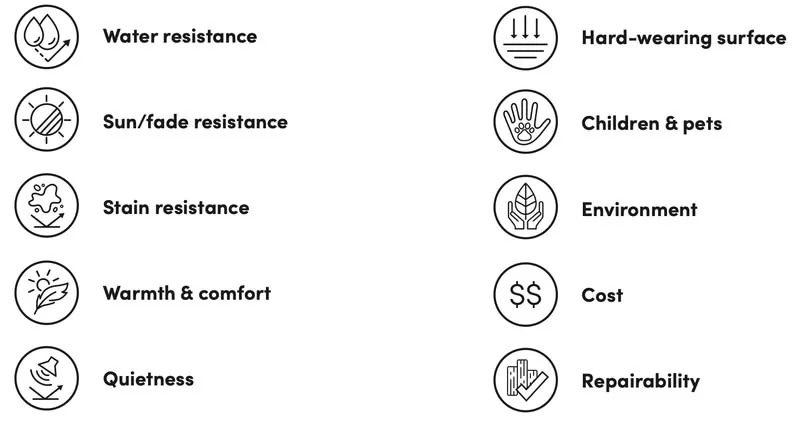
Performance is an essential factor to quality flooring. Many wise consumers will tend to focus on the factors that are most relevant to their daily life; for example, families with pets may weigh stain resistance and hard‑wearing surface higher.
Different Types of Hard Surface Flooring Product Comparison
When it comes to different types of hard surface floorings, there are mainly four types of flooring that consumers frequently compare with.
| Product | Water | Scratch Resistance | Stain Resistance | Sun / Fade | Noise Reduction | Typical Features |
|---|---|---|---|---|---|---|
| Wood / Timber Flooring | Medium‑Low – High (varies by finish) | High | Medium‑Low – High | High | Low‑Medium | Classic aesthetic, solid or engineered |
| Laminate Flooring | Medium‑Low | High | High | High | Low‑Medium | Budget‑friendly, high durability |
| Cork Flooring | High (first rating) / Low (second) | Medium‑Low | Medium‑Low (first) / High (second) | High | Medium‑Low | Warm, quiet, antibacterial |
| Hybrid Vinyl Flooring (Vinyl/SPC/WPC) | High (first) / Medium‑Low (second) | Medium‑Low (first) / High (second) | Medium‑Low (first) / Low (second) | Medium‑Low | Medium‑Low (first) / Low (second) | Fully waterproof, ideal for wet areas |
*Ratings are taken from the performance scales shown in the guide; “High” denotes superior performance, and “Low” indicates limited capability.*
Wood / Timber Flooring Features
- Design range – Limited species compared with engineered or laminate options; exotic woods are specialty items.
- Value & aesthetics – Real wood adds undeniable warmth and can increase resale price.
- Aging – Patinas change color with light; scratches & dents accumulate over time.
- Maintenance – Sensitive to humidity, temperature, and water; requires periodic refinishing.
- Installation – Typically glued or nailed; least DIY‑friendly, highest material & labor cost.
- Durability – Strong but vulnerable to moisture damage and pests (e.g., termites).
Laminate Flooring Features
- Expansion limitation: most brands recommend a transition (T‑molding) every 30–50 ft to accommodate movement.
- Value proposition – High‑end looks at mid‑range price points; excellent cost‑benefit.
- Durability – Scratch‑resistant, stain‑resistant; many products now 100 % water‑tight.
- Comfort – Softer underfoot than tile or hardwood; good for long standing periods.
- Installation – Click‑lock floating system; very DIY‑friendly and low installation cost.
- Drawbacks: Hollow, “clicky” sound under hard footwear. Visible repeat patterns over large areas.
Hybrid Vinyl Flooring Features
- Caution – Wide quality range; avoid the cheapest products—low‑cost LVP often performs poorly and fails quickly if installed improperly.
- Design variety – Broadest selection of wood‑tone, stone‑tone, and color options; rapidly expanding market.
- Waterproofing – More water‑resistant than laminate; ideal for moisture‑prone zones.
- Durability – Solid but slightly less scratch‑resistant than laminate.
- Installation – Floating click‑install; DIY‑friendly but requires a perfectly flat, level subfloor. Poor subfloor prep leads to early failure.
Key Takeaways per Category
- Wood/timber flooring offers timeless charm but may need more maintenance.
- Laminate flooring provides excellent wear resistance at a lower cost.
- Cork flooring excels in water and sun resistance plus quietness.
- Hybrid resilient flooring is the only fully waterproof option, suited for bathrooms and laundries.
Joint Systems
There are two reliable installation methods that dominated the flooring market:
| Joint System | Description | Typical Application |
|---|---|---|
| T&G (Tongue‑and‑Groove) | Traditional glued timber boards with a tongue fitting into a groove. | Glued solid or engineered timber floors |
| Angle Click System | Mechanical interlocking for floating floors; no glue required. | Hybrid, laminate, and cork floating installations |
How Other Accessories matter in Floorings?
Underlay
Underlayment plays an essential role in the comfort and quietness of the flooring. Underlayments generally come in two forms: one in individual rolls and the other form in pre-attached styles with the flooring planks.
- Standard underlay – masks minor sub‑floor imperfections.
- Noise‑reducing underlay – cuts footfall noise by up to 30 %, ideal for apartments and open‑plan homes.
Trims
- Standard metal trim (silver/champagne) – joins floating floors to windows.
- Powder‑coated trim – colour‑matched to adjacent carpet.
- Laminated trim – Trims that are laminated with the same surface of laminate flooring or resilient vinyl flooring. The matching colors offer a more consistent design in flooring interiors.
- Primed Trim – Primed trims are generally in white, and are designed for painting after the trims are installed in position.
- Incizo trim – wider wood‑look profile for seamless carpet transitions.
Sustainability in Different Types of Hard Surface Floorings
Sustainability is one of the most important factors that consumers should be aware of. As different hard-surface floorings do have different sustainability factors, some are more seriously concerned, while others are less concerned by the public.
| Type of Flooring | Main Material Composition | Environmental Advantages | Environmental Disadvantages |
|---|---|---|---|
| Hardwood Flooring | Solid Hardwood, processed plywood | Being a natural and bio-based material, it provides an environmentally friendly option. | Hardwood takes extensive time to regrow and is not considered an effective renewable resource. |
| Laminate Flooring | High-density fiberboard | Bio-based materials that are manufactured from shredded wood. | The use of adhesive to bond the wood fibre together |
| Resilient Vinyl Flooring | Polyvinyl chloride, calcium carbonate | – | Very limited mechanical recycling, which results in low recyclability. Chemical recycling produces additional toxic emissions. |
| Cork Flooring | Cork | Renewable resource with rapid growth for effective natural materials in flooring. | Cork composition is too soft and has constraints on use as a flooring material. The locking system in cork flooring has distinctive weakness in rigidity and strength. |
| Bamboo Flooring | Bamboo and bamboo fibers | Renewable resource with rapid growth for effective natural materials in flooring. | The natural appearance of bamboo wood is very limited in design and colors. |
| PVC Free Resilient Flooring | Polyolefin: Polyethylene and polypropylene | A truly recyclable composition with low VOC and GHG emissions across its product life cycle. | Polyolefin polymers are more expensive than PVC polymers. |