
Luxury Vinyl Tile LVT product categories has gained significant market shares as one of the top selling and most popular products in floor coverings. However, with increasing concerns over the use of PVC polymers in LVP flooring, flooring brands and suppliers are progressively working on developing non-vinyl, PVC free rigid core PP floorings.
What is PVC Free Rigid Core PP Floorings
PVC Free Rigid Core PP Floorings are made from Polypropylene composition. It is the next generation flooring product that replace the PVC based rigid core SPC floorings. With polypropylene’s natural properties, SPC made of PP composition will have an outstanding performance compare to PVC based SPC planks. Some of the product advantages includes improving dimensional stability and curling performance. PP based SPC are also easier to recycle so it can contribute to better for flooring recycling and takeback.
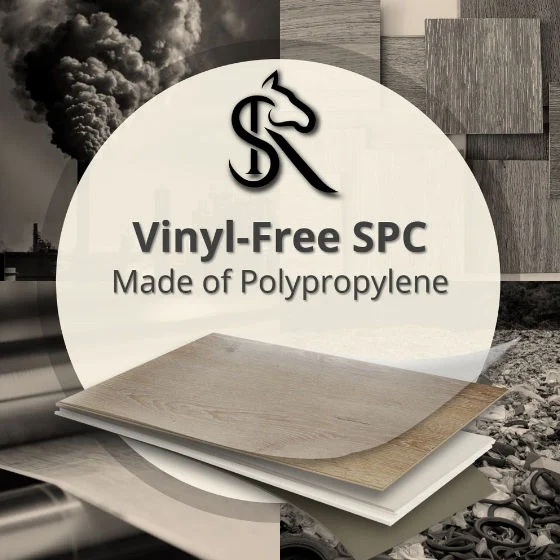
Major benefits in PP based SPC
- Greater dimensional stability
- Improved curling performance
- Truly recyclable
- Helps for flooring takeback program and upcycle
- Truly toxic free when burned
Why Flooring Businesses should consider Launching PP based SPC?
There are many good reasons why flooring business should consider launching PP based SPC as part of their floor product offering. The very first reason is performance factors. With improving stability and curling performance, the polypropylene based SPC does not need to be acclimated before installation. This significantly saves builder and contractors’ project time. Being a acclimation free flooring, the project will have less risk from product failure. Saving time and potential costs from flooring failure.
The second aspect about launching PP based SPC is the fact that it is a more environmental flooring product. Some green building project requires all building materials it use is Red-List Free. PVC based SPC therefore loss out on winning these green building projects. By able to offer PVC-free based SPC, flooring business will have greater opportunities to work with these special building projects, and with a better profit margin too.
The third factor for PP based SPC is that it is truly recyclable material. Flooring brands has a interest to launch PP based flooring as it align with their ESG strategies for end of life product take-back program. While smaller flooring businesses, especially for floor retailers, does not have the capability to offer the same product take-back program, by having these eco-friendly SPC collections can still bring positive impact for the business. There are consumer niche that are really concerned about sustainabilities in their flooring product, and PP based SPC can capture that market niche.
Better Performance with Polypropylene SPC
When comparing polyvinyl chloride with polypropylene, polypropylene polymers has a better performance in both high and extremely low temperatures. The vicat point (softening temperature)for polypropylene is between 130°C and 170°C (266°F – 338°F), while for polyvinyl chloride (PVC) is only between 72°C and 82°C (162°F–180°F). Therefore during the changing seasons between summer and winter, PVC based SPC flooring are more vulnerable to deform and dimensional change.
Due to distinctive temperature performance with polypropylene, SPC products that are made from compositions of polypropylene has an improving dimensional stability and curling. With advanced formula, polypropylene based SPC can also achieve acclimation free performance, saving time for builders and renovation projects alike.
Improving Environmental Safety with Polypropylene SPC
Polyvinyl Chloride contains chloride which is considered a potential toxic chemical for the environment. In fact, chloride is also listed as one of the most toxic substance according to the International Living Future Institute. When PVC polymers are burned, it will produce a black smoke due to higher smoke density with hydrogen chloride and dioxins, both are hazardous chemicals for humans, animals, and plants. Polypropylene on the other hand, only produce white smoke when burned, indicating a clean combustion that leaves no harmful chemical substances to the environment.
Enable Sustainability through Recycling with Polypropyle SPC
Polypropylene can be easily recycled through mechanical methods. While for polyvinyl chloride, it needs to go through chemical treatments to effectively be recycled. In practice, more than 90% of PVC wastes are either dumped or burned, which continues to be a major plastic waste problem. Even under chemical recycling methods, the use of additional chemicals to recycle are also criticised.
While many flooring brands claim that their PVC based products are 100% recyclable, it is not done in practice. Hence major brands are preparing to launch PVC-free resilient flooring products. Polypropylene based SPC is a sustainable and true recyclable product that is being promoted by some of these leading brands.