
The page serves as a technical manual for understanding hardwood as a natural material and a primary medium for building material craftsmanship. Wood is a complex, renewable resource whose utility is dictated by its cellular structure, growth patterns, and chemical composition.
Critical takeaways from the source materials include:
- Structural Dichotomy: Wood is categorized into softwoods (conifers) and hardwoods (broad-leaved trees). These classifications are botanical rather than physical, as some “softwoods” can be physically harder than “hardwoods.”
- Moisture Dynamics: Wood is a hygroscopic material. Managing moisture through seasoning (air or kiln drying) is essential to prevent defects such as warping, checking, and splitting. Shrinkage occurs primarily once moisture levels drop below the “fiber-saturation point” (approximately 30%).
- Processing and Conversion: The method of milling (plainsawn, quartersawn, or riftsawn) significantly impacts the stability, appearance, and cost of the lumber.
- Material Innovation: Modern woodworking utilizes engineered solutions like veneers and man-made boards (plywood, chipboard, MDF) to enhance stability, achieve decorative figures, and utilize resources more economically.
- The Finishing Continuum: High-quality results depend on rigorous surface preparation—sanding, filling, and grain sealing—followed by the application of finishes ranging from traditional French polishing to modern catalyzed lacquers and spray-applied paints.
Introduction to Hardwood Materials
I. The Biological Structure of Wood
Understanding the growth and structure of a tree is fundamental to anticipating how wood will behave during construction.
A. Classification and Growth
- Softwoods (Gymnospermae): These are generally needle-leaved, cone-bearing trees (conifers). Most are evergreen, though some, like Larch, are deciduous.
- Hardwoods (Angiospermae): Broad-leaved trees that produce seed-bearing ovaries (flowers/fruit). In temperate zones, these are typically deciduous, while tropical varieties may be evergreen.
- Photosynthesis: The process by which leaves use chlorophyll, sunlight, water, and carbon dioxide to produce nutrients (sugars), releasing oxygen as a byproduct.
B. Anatomical Components
| Component | Function/Description |
|---|---|
| Cambium Layer | A thin layer of living cells between the bark and the wood where new growth occurs. |
| Sapwood | The outer, younger layers of wood that conduct water and nutrients; usually lighter in color and more susceptible to decay. |
| Heartwood | The mature, non-living center of the tree; it provides structural support and often contains extractives that provide rich color and decay resistance. |
| Growth Rings | Formed by the contrast between “earlywood” (rapid spring growth, thin-walled cells) and “latewood” (slower summer growth, thick-walled cells). |
| Ray Cells | Cells radiating horizontally from the center of the tree to store and carry nutrients. |
II. Wood Processing: From Log to Lumber
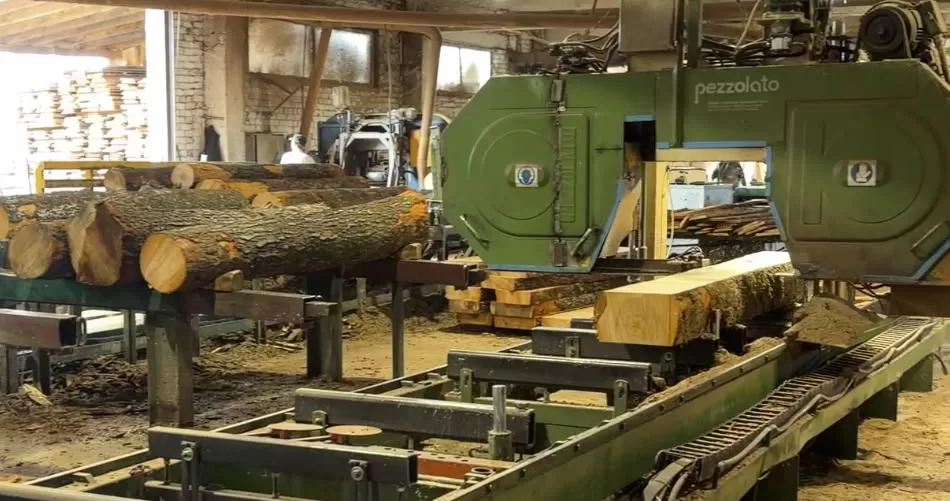
The transition from a felled tree to usable timber involves precise milling and seasoning techniques.
A. Milling (Conversion)
- Plainsawn: The most economical method; produces boards with a distinctive “U” shaped grain pattern. It is prone to more movement.
- Quartersawn: Boards are cut radially (at least 45 degrees to the growth rings). This produces stable wood with “silver-fleck” figures in species like oak but is more wasteful and expensive.
- Riftsawn: Cut at an angle between 30 and 60 degrees to the growth rings to produce a straight-grain appearance.
B. Seasoning and Moisture Control
Green wood contains “free water” in cell cavities and “bound water” in cell walls.
- Fiber-Saturation Point (FSP): Occurs at approximately 30% moisture content. Shrinkage and distortion only begin when moisture is lost from the cell walls below this point.
- Drying Methods:
- Air-drying: Inexpensive but slow (roughly one year per inch of thickness for hardwoods). Reduces moisture to 14–16%.
- Kiln-drying: Uses controlled heat and humidity to reduce moisture to 6–10%, making the wood suitable for interior use.
- Stability: Wood shrinks more tangentially (along the rings) than radially. This differential leads to warping, cupping, and “parallelogramming” in square sections.
III. Material Selection and Identification
Wood selection is a process of balancing strength, workability, cost, and aesthetics.
A. Grading Systems
- Softwoods: Graded by “appearance grades” (for finish work) and “nonstress grades.”
- Hardwoods: Graded by the area of defect-free wood. The highest grade is “Firsts and Seconds” (FAS).
B. Common Defects
- Shakes: Splits occurring along the growth rings.
- Checks: Splits caused by uneven drying; “honeycomb checks” occur inside the board.
- Warping/Bowing/Spring: Distortions caused by internal stresses or poor seasoning.
C. Species Characteristics (Sample)
- Cedar: Aromatic, decay-resistant, and lightweight.
- Oak (Red/White): Hard, strong, and characterized by prominent ray cells. White oak is impervious to water.
- Mahogany (Brazilian): Medium-textured with straight, even grain; highly prized for furniture.
- Balsa: Botanically a hardwood, but physically the softest and lightest commercial timber.
- Yew: A tough, hard softwood with decorative orange-red heartwood.
IV. Engineered and Decorative Materials
A. Veneers
Veneers are thin “leaves” of wood (often 0.6mm or 1/40 in) cut for decorative or economic purposes.
- Production Methods: Rotary cutting (peeling a continuous sheet), flat slicing (for crown-cut figure), and quarter-slicing (for striped figure).
- Decorative Figures: Include “Burl” (abnormal growths), “Crotch” (where the trunk divides), and “Bird’s-eye” (small, circular grain distortions).
B. Man-Made Boards
| Board Type | Construction | Use Case |
|---|---|---|
| Plywood | Layers of veneer (plies) bonded with grain at right angles. | Structural work, cabinetry; highly stable. |
| Blockboard | Core of solid wood strips faced with veneer. | Shelving and worktops. |
| Particleboard | Chips or flakes of wood bonded under pressure. | Economy furniture, flooring (underlayment). |
| MDF | Wood fibers pressed with resin. | High-quality painted finishes, moldings. |
V. Surface Preparation and Finishing
A superior finish is only achievable through meticulous preparation.
A. Surface Preparation
- Filling: Holes and cracks are managed with wood putty, cellulose filler, or shellac/wax sticks color-matched to the species.
- Sanding: Utilizing abrasive papers in a progression from coarse to very fine.
- Grades: Very Coarse (40–60), Medium (120–180), Very Fine (320–600).
- Raising the Grain: Dampening the wood to lift severed fibers, which are then sanded off after drying to ensure a smooth final finish.
B. Staining and Bleaching
- Stains: Available as water-based (deep penetration, raises grain), oil-based (easy to use, does not raise grain), or alcohol-based (fast-drying).
- Fuming: Using ammonia fumes to chemically darken woods containing tannic acid (especially Oak).
C. Finishing Materials
- French Polish: A traditional finish made of shellac (a secretion of the lac insect) dissolved in alcohol. It creates a high-gloss, “glass-like” texture.
- Lacquers: Often nitrocellulose-based; they dry by solvent evaporation. Catalyzed lacquers use a hardener for increased durability.
- Varnishes: Synthetic resins (polyurethane) that are heat and water-resistant.
- Oils/Waxes: Traditional finishes (Linseed, Tung, Danish oil) that penetrate the wood rather than coating the surface, providing a natural look.
D. Application Methods
- Brushing: Requires high-quality brushes and careful technique to avoid “runs” or “curtaining.”
- Spraying: Utilizing a spray gun and compressor. It is the fastest method but requires a controlled environment (spray booth) and safety equipment due to volatile fumes.
- Wiping: Common for oils and waxes, utilizing a lint-free cloth (rubber) for application and burnishing.
Hardwood Selection Guide – Wood Species & Structural Performance
1. Botanical Taxonomy and the Fundamental Classification of Timber
In the discipline of materials architecture, the strategic selection of timber begins with botanical taxonomy. This classification is not merely a scientific formality; it is an analysis of evolutionary biology that dictates the cellular blueprint and structural potential of the material. By identifying the botanical order, a technologist can predict fundamental mechanical behaviors, durability, and moisture response before a single cut is made.
Timber is synthesized into two primary groups based on their reproductive and physiological evolution: Gymnospermae (Softwoods) and Angiospermae (Hardwoods).
| Attribute | Gymnospermae (Softwoods) | Angiospermae (Hardwoods) |
|---|---|---|
| Leaf/Seed Characteristics | Needle-shaped or scale-like leaves; “naked” seeds typically borne in cones. | Broad-leaved; seeds enclosed within a fruit, nut, or ovary. |
| Cellular Complexity | Simple structure; primarily comprised of tracheids (long, fiber-like cells). | Complex structure; contains specialized vessels or pores for fluid conduction. |
| Evolutionary Complexity | Regarded as a more primitive, older evolutionary order. | Regarded as a higher, more specialized evolutionary order. |
| Typical Environments | Predominantly temperate/subarctic; most are evergreen (conifers). | Temperate and tropical regions; can be deciduous or evergreen. |
It is a common professional fallacy to equate the terms “softwood” and “hardwood” with physical density. In reality, these are botanical distinctions. A classic example is Balsa (Ochroma lagopus), which is botanically a hardwood (an Angiosperm) despite being physically the softest commercial timber available. Conversely, several softwoods exhibit higher physical hardness than many hardwoods. This botanical identity serves as the foundation for understanding the internal structural mechanics of the tree.
2. Anatomical Architecture: Growth, Structure, and Density
A granular understanding of tree anatomy is essential for predicting material stability and long-term project viability. The biological history of a tree, recorded in its grain and rings, informs the technologist of how a board will respond to environmental stressors.
The growth cycle is driven by the Cambium layer, a thin band of active living cells located between the bark and the wood. During the growing season, these cells sub-divide to form new wood (xylem) on the interior and phloem (inner bark) on the exterior. This process yields three critical zones:
- Cambium: The engine of annual growth.
- Sapwood: The outer, lighter-colored rings. These living cells conduct sap and store nutrients. Due to high starch content, sapwood is more susceptible to insect attack and fungal decay.
- Heartwood: The mature, structural spine of the tree. As sapwood cells die, they become blocked with organic chemicals known as extractives. These extractives provide heartwood with its characteristic color and increased resistance to fungi and insects.
Climatic conditions divide the annual ring into Earlywood (Springwood) and Latewood (Summerwood). Earlywood, formed during rapid spring growth, consists of thin-walled cells designed for sap conduction. Latewood develops later in the season with thicker-walled cells, providing structural support and appearing as a denser, darker band. The width of these rings reveals the growth history: wide rings indicate favorable conditions, while narrow rings signal poor growth or drought.
The longitudinal orientation of these cellular structures defines the “direction of the grain.” While branches yield smaller limb wood, the trunk—or bole—is the primary source of commercial timber, providing the volume and consistency required for industrial application. These internal biological structures are the direct precursors to the visible aesthetic and tactile properties of the finished material.
3. Evaluative Criteria for Physical Properties and Aesthetics
Material selection for the master wood technologist is the precise balancing of strength, workability, and visual figure. These “Properties of Wood” are determined by the nature of its cell structure.
Grain, Figure, and Texture
- Grain: Refers to the longitudinal cell direction. Straight grain follows the main axis of the trunk. Spiral grain occurs when a tree twists during growth. Interlocked grain results from the grain direction shifting over successive years, while Wavy grain indicates a constant undulating cell structure.
- Figure: The visual pattern created by growth rings and Ray Cells (medullary rays). Ray cells radiate horizontally from the center. When wood is cut radially (Quartersawn), these rays are exposed on the face, creating a distinctive “silver-fleck” or “ray-fleck” figure.
- Texture: Dictated by the size and distribution of cells. Fine-textured woods have small, closely spaced cells. Coarse-textured woods (like Oak) have large cells or vessels, often requiring grain fillers for high-gloss finishes.
Weight and Density
Weight is expressed as “Average Dried Weight” and is intrinsically linked to moisture management. The Fiber-saturation point occurs at approximately 30% moisture content. At this point, “free water” has left the cell cavities, but “bound water” remains within the cell walls. It is critical to note that shrinkage and structural movement only begin once moisture starts to be lost from the cell walls themselves.
These physical traits dictate the specific conversion processes required to prepare the timber for stable use.
4. Conversion Dynamics and Stability Management
Milling and seasoning are the primary influencers of board stability. The method of conversion determines how the wood will “move” in response to humidity.
Milling Techniques
- Through-and-through: The most economical method, involving parallel cuts through the whole log. This produces mostly plainsawn boards.
- Plainsawn: Boards cut on a tangent to the annual rings (growth rings meet the face at less than 45°). These display a distinctive elliptical figure but are prone to cupping.
- Quartersawn: Boards where growth rings meet the face at not less than 45°. This is the preferred type for flooring and furniture-making as it results in little or no distortion across the width.
- Riftsawn: Boards with growth rings meeting the face at 30° to 60°, producing a straight grain with minimal ray patterning.
Seasoning (Drying)
Seasoning removes moisture to reach the Equilibrium Moisture Content (EMC).
- Air-drying: Boards are stacked on stickers (spacers) to allow airflow. As a rule of thumb, this takes one year for every 1 inch (25mm) of thickness for hardwoods and approximately half that time for softwoods.
- Kiln-drying: A controlled process using heat and steam to reach the 6% to 8% moisture content required for interior stability.
Wood Defects
Stresses during growth or drying manifest as:
- Surface checking: Shallow splits caused by the exterior drying faster than the interior.
- Honeycomb checks: Internal splits that occur when the interior shrinks more than the outside; these are often invisible until the wood is machined.
- End-splits: Splits at the ends of boards caused by rapid drying of the end grain.
- Distortion (Warping): Includes Bow (lengthwise curve), Spring (edge-wise curve), Twist, and Cup (cross-sectional curve). These movements are dictated by the orientation of the annual rings.
5. Softwood Species Profile and Application Analysis
Softwoods are valued for their straight growth, availability, and cost-effectiveness in construction and joinery.
Cedar, Western Red (Thuja plicata)
- Physical Characteristics: Reddish-brown, fading to silver-grey; straight grain. Average dried weight: 23 lb/ft³ (370 kg/m³).
- Workability & Finishing: Good workability; high decay resistance.
- Industrial Utility: Exterior cladding, greenhouses, and sheds.
Douglas Fir (Pseudotsuga menziesii)
- Physical Characteristics: Reddish-brown with pronounced, straight grain. Average dried weight: 33 lb/ft³ (530 kg/m³).
- Workability & Finishing: Good workability; finishing is rated as fair.
- Industrial Utility: Heavy construction and North American joinery.
Western Hemlock (Tsuga heterophylla)
- Physical Characteristics: Pale brown wood with distinct growth rings. Average dried weight: 31 lb/ft³ (500 kg/m³).
- Workability & Finishing: Good workability and finishing.
- Industrial Utility: Standard construction, joinery, and plywood.
Larch (Larix spp.)
- Botanical Detail: A unique conifer that sheds its needles in winter.
- Physical Characteristics: Tough, straight-grained with rich-red heartwood. Average dried weight: 37 lb/ft³ (590 kg/m³).
- Workability & Finishing: Medium workability; fair finishing.
- Industrial Utility: Boat planking, exterior construction.
Pine (e.g., Ponderosa) (Pinus spp.)
- Physical Characteristics: Pale yellow to reddish-brown; non-resinous and even texture. Average dried weight (Ponderosa): 30 lb/ft³ (480 kg/m³).
- Workability & Finishing: Good workability; fair to good finishing.
- Industrial Utility: Furniture, doors, and pattern-making.
6. Hardwood Species Profile and Performance Evaluation
Hardwoods offer superior durability and complex aesthetic figures for high-performance applications.
Ash (White/European)
- Structural Evaluation: 42 lb/ft³ (670 kg/m³). Ring-porous; coarse texture.
- Master Analysis: Its high shock resistance makes it the definitive choice for baseball bats and tool handles.
- Source: North America / Europe.
Beech (European)
- Structural Evaluation: 45 lb/ft³ (720 kg/m³). Diffuse-porous; fine, even texture.
- Master Analysis: Favored for chair-making and “steamed” furniture due to its hardness and even-wearing properties.
- Source: Europe.
Birch (Yellow)
- Structural Evaluation: 44 lb/ft³ (710 kg/m³). Diffuse-porous; fine, even texture.
- Master Analysis: High hardness makes it a staple for quality plywood and turned items.
- Source: North America.
Mahogany (Brazilian)
- Structural Evaluation: 35 lb/ft³ (560 kg/m³). Diffuse-porous; medium texture with interlocked grain.
- Master Analysis: The gold standard for prestige furniture due to its exceptional stability and rich luster.
- Conservation Status: Endangered (Marked with felled-tree symbol).
Oak (White)
- Structural Evaluation: 48 lb/ft³ (770 kg/m³). Ring-porous; coarse texture.
- Master Analysis: Preferred for exterior use and cooperage (barrels) because it is impervious to water.
- Source: North America / Europe.
Walnut (Black)
- Structural Evaluation: 41 lb/ft³ (660 kg/m³). Semi-ring porous; medium to coarse texture.
- Master Analysis: Sought-after for high-end cabinetry and gunstocks due to its rich, dark purplish hues.
- Source: North America.
Teak
- Structural Evaluation: 41 lb/ft³ (660 kg/m³). Ring-porous; coarse, uneven texture with an oily feel.
- Master Analysis: Natural oils provide unmatched durability for marine environments and boat building.
- Conservation Status: Endangered (Marked with felled-tree symbol; at risk in natural forests).
The professional materials architect carries the responsibility of matching these specific species properties to environmental and structural requirements while remaining cognizant of the conservation status of high-value timbers such as Afrormosia and Brazilian Rosewood.
Timber Quality Assessment & Seasoning Management Handbook
1. Fundamental Wood Anatomy and Structural Properties
Technical quality control in timber management begins with a rigorous understanding of the tree as a biological organism. The physical performance of lumber—its strength, stability, and reaction to environmental changes—is fundamentally dictated by the cellular architecture developed during the tree’s life. By analyzing these internal structures, a quality assurance professional can predict how a specific piece of timber will behave once it is integrated into a structural or aesthetic application.
Structural Analysis: Sapwood, Heartwood, and Growth Cycles
The transition from a living tree to industrial lumber involves several key biological distinctions that influence durability and moisture behavior:
- Sapwood vs. Heartwood: Sapwood is the younger, outer layer of the tree, consisting of living cells that conduct water (sap). It is generally lighter in color and more susceptible to fungal decay and insect attack due to the carbohydrates stored in its cells. Heartwood, the “structural spine” of the tree, is formed as older sapwood cells die and become blocked with chemical substances called extractives. These extractives provide heartwood with its rich color and superior resistance to decay and beetle attack.
- Earlywood vs. Latewood: Within a single growth ring, wood is divided into earlywood (springwood) and latewood (summerwood). Earlywood consists of thin-walled cells formed during rapid spring growth, making it lighter and easier to cut. Latewood cells, formed later in the season, have thicker walls, are darker and denser, and provide the primary structural support.
Specialized Terminology
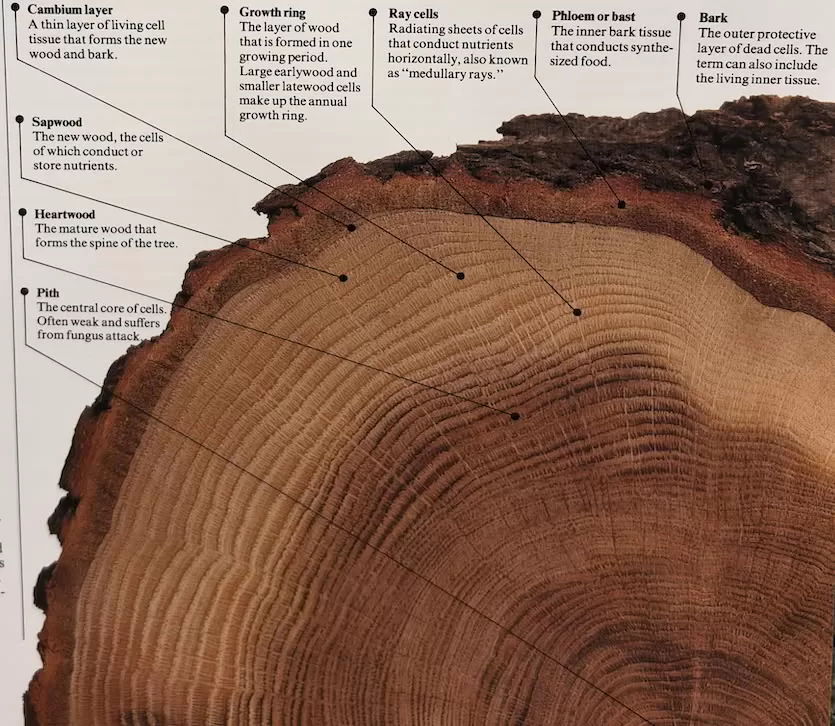
Based on the biological structures in natural woods, the following components are critical to quality assessment:
- Pith: The central core of the trunk; often weak, soft, and prone to decay.
- Cambium Layer: A thin layer of active living cells between the bark and the wood where new growth occurs.
- Medullary Rays: Radiating sheets of cells that conduct nutrients horizontally. They are plainly obvious in hardwoods like oak when quartersawn.
- Xylem: The main body of the tree; tissue that conducts water and minerals from the roots to the leaves.
- Phloem (Bast): The inner bark tissue that conducts synthesized food to all parts of the plant.
Cell Distribution and Texture
The distribution of vessels or “pores” classifies timber texture. Ring-porous hardwoods (e.g., oak or ash) have clearly defined rings of large vessels in the earlywood, creating a prominent texture. Diffuse-porous hardwoods (e.g., beech or mahogany) have vessels distributed relatively evenly throughout the growth ring, resulting in a finer, more uniform texture that is generally easier to work and finish. These internal biological structures determine the tree’s reaction to the mechanical stress of milling.
——————————————————————————–
2. Strategic Wood Conversion and Dimensional Stability
The strategic selection of a milling method is a critical intervention in the value chain. Correct conversion maximizes the yield of usable timber while minimizing the inherent tendency of wood to deform. The orientation of the saw relative to the annual growth rings determines both the visual “figure” of the board and its long-term stability.
Comparative Milling Techniques
- Plainsawn (Flat-grain): The most economical method where the log is cut “through and through” (parallel cuts through the length of the log). It produces a distinctive elliptical figure but is the least stable and most prone to cupping.
- Quartersawn: Boards are cut radially, with growth rings perpendicular to the face (at least 45 to 90 degrees). This results in a straight-grained appearance and reveals “silver-fleck” ray patterns in species like oak. It is highly stable and resistant to distortion.
- Riftsawn: Boards where growth rings meet the face at an angle between 30 and 60 degrees, providing a straight grain without the prominent ray patterning of true quartersawing.
Reaction Wood and Economic Trade-offs
Inspectors must identify Reaction Wood, caused by asymmetric growth rings when a tree leans or grows under stress. In softwoods, this is compression wood, which forms on the underside of the lean. In hardwoods, it is tension wood, forming on the upper side. These growth anomalies produce internal stresses, leading to unpredictable movement and splitting during and after conversion.
While “through and through” sawing offers maximum yield efficiency, the resulting mix of plainsawn boards often lacks the reliability of quartersawn timber. For high-end applications, the higher cost of quartersawing is a necessary investment to ensure material longevity and prevent structural failure.
——————————————————————————–
3. Technical Seasoning and Moisture Content (MC) Control
Seasoning is the vital transition of “Green Wood”—freshly felled timber saturated with moisture—into a stable industrial material. Without controlled seasoning, wood is susceptible to structural failure, including splitting, rot, and severe distortion.
The Threshold of Stability: Fiber-Saturation Point
The Fiber-Saturation Point (FSP) occurs at approximately 30% moisture content. Above this point, only “free water” in cell cavities is lost, and the wood does not shrink. Once MC drops below 30%, “bound water” leaves the cell walls, triggering physical shrinkage. The objective is to reach the Equilibrium Moisture Content (EMC), where the wood’s moisture level is in balance with the relative humidity of its final environment.
Moisture Content Calculation
Moisture content must be calculated using the following technical formula:
Moisture Content % = [Oven dry weight of sample / Weight of water lost from sample]×100
Comparative Drying Methodologies
| Feature | Air-Drying | Kiln-Drying |
|---|---|---|
| Target MC | 14% – 16% (Exterior use) | 6% – 8% (Interior use) |
| Timeframe | 1 year per 1 in (25mm) for hardwoods; 1/2 year for softwoods. | Rapid (days to weeks) |
| Control | Natural airflow; inconsistent. | Precise heat and steam regulation. |
Industrial QA relies on these timeframes to prevent stresses within the wood that lead to post-production defects.
4. Identification and Classification of Timber Defects
The “Quality Inspector’s Eye” is essential for identifying flaws early to prevent costly project failures. Inspectors should sight along the length to check for bowing and look at the end section to identify the cut from the log and any internal separations.
Defect Catalog: Diagnostic Descriptions
Separations (Internal and External Failures)
- Shakes: Splits along growth rings (Ring Shakes) or radiating from the pith (Star Shakes).
- Surface Checking: Small splits on the face caused by rapid surface drying.
- Honeycomb Checking: Internal splits occurring when the interior shrinks more than the exterior; often invisible until the wood is cut.
- End Splits: Separations at board ends caused by rapid drying of the end grain; can be minimized with wax or paint.
Distortions (Shape Failures)
- Bowing: A longitudinal curve along the face.
- Springing: A longitudinal curve along the edge.
- Twisting: A spiral distortion where the four corners are no longer in the same plane.
- Cupping: A transverse curve across the width, typical of tangentially cut plainsawn boards.
Case Hardening: A severe drying defect where the surface dries too quickly, trapping internal tension. This makes the timber functionally useless for resawing, as the release of internal stress causes immediate, severe bowing.
5. Selection Standards for Solid Timber and Man-Made Boards
Professional grading ensures material is fit for purpose. Softwoods are graded into Appearance Grades (for aesthetics and joinery) and Stress/Non-stress Grades (rated for structural load-bearing). Hardwoods are graded by the area of defect-free wood, with “Firsts and Seconds” (FAS) as the premier grade.
Commercial Species Profile Summary
- Douglas Fir: Straight-grained, reddish-brown. Average dried weight: 33lb/ft3 (530kg/m3). Workability: Good.
- White Oak: Tough, durable, and water-impervious. Average dried weight: 48lb/ft3 (770kg/m3). Workability: Good.
- Teak: Oily texture, exceptionally moisture-resistant. Average dried weight: 41lb/ft3 (660kg/m3). Workability: Good.
- Western Red Cedar: Lightweight and rot-resistant. Average dried weight: 23lb/ft3 (370kg/m3). Workability: Good.
- European Beech: Fine-textured, straight-grained. Average dried weight: 45lb/ft3 (720kg/m3). Workability: Medium.
Engineered Material Standards
- Plywood: Utilizes Balanced Construction (odd number of plies) glued at right angles to ensure dimensional stability and prevent splitting.
- Blockboard vs. Laminboard: Both feature solid wood cores between veneers. Laminboard uses narrow core strips (1/8 in to 1/4 in / 3 to 7mm), making it superior for high-end veneers. Blockboard uses wider strips (up to 1 in / 25mm), which can “telegraph” or show through the surface veneer.
- Fiberboards (MDF): Wood fibers bonded under heat/pressure, providing a uniform structure excellent for painted finishes.
6. Remediation, Surface Preparation, and Protective Finishing
The final quality checkpoint ensures the surface is prepared for longevity and performance.
Preparation Protocols
- Remediation: Minor defects are addressed with wood putty, wax sticks, or shellac sticks (melted into cracks with a soldering iron).
- Raising the Grain: Wood is dampened to cause crushed fibers to swell. Once dry, a light sanding removes these fibers, preventing a rough texture when the final finish is applied.
- Sanding Grades: Progress from Coarse (60-80 grit) for initial smoothing to Very Fine (320-500 grit) for polishing finishes like French Polish.
Finishing Matrix
| Finish Type | Characteristics | Professional Note |
|---|---|---|
| Oils/Waxes | Penetrative; enhances color. | Best for oily woods like Teak. |
| Shellac (French Polish) | High-gloss Victorian standard; derived from the lac insect. | Highly vulnerable to white rings from alcohol or water. |
| Lacquers/Varnishes | Heat, moisture, and abrasion resistant. | Polyurethane is the standard for flooring and exterior use. |
Safety Directive: Surface Finishes
- Fire Risk: Oily rags can undergo spontaneous combustion; they must be spread flat to dry outdoors.
- Operational Safety: No smoking or naked flames are permitted during application. Install fire extinguishers in all finishing areas.
- Health: Ensure adequate ventilation or wear a respirator when spraying to avoid inhaling toxic solvent fumes.
Maintaining these professional standards from the living tree to the finished surface ensures the highest level of industrial quality and timber performance.
From Forest to Furniture: The Art and Science of Wood Conversion
To master the craft of woodworking, one must look beyond the surface of a board and understand the biological life of the tree from which it was yielded. Wood conversion is not merely the act of slicing a log; it is a systematic science that accounts for cellular structure, moisture physics, and mechanical stability. As an instructor, I expect you to understand that every defect or beautiful figure you encounter at the workbench was predetermined long before the timber reached the mill.
1. Foundations: The Biology of a Board
The quality and behavior of finished lumber are dictated by the anatomy of the tree. A tree grows through the annual deposition of cells formed by the cambium layer. As the trunk increases in girth, specialized tissues take on roles that determine the wood’s durability, color, and figure.
| Part of the Tree | Biological Function | Value to the Woodworker |
|---|---|---|
| Cambium Layer | A thin layer of living cells that divides to form new wood (xylem) and bark. | The engine of growth; determines the consistency and definition of the annual rings. |
| Sapwood | Younger, outer wood that conducts sap and stores nutrients. | Light-colored and porous; absorbs stains and preservatives easily but is highly susceptible to rot and beetle attack. |
| Heartwood | Mature inner wood formed when sapwood cells die and are blocked with organic extractives. | The “structural spine”; extractives provide rich color and essential resistance to fungi and insects. |
| Phloem (Bast) | Inner bark tissue that conducts synthesized food from the leaves to the rest of the tree. | Critical for tree health, though usually removed during the debarking process at the mill. |
| Pith | The central core of the trunk, consisting of the original stem tissue. | A point of weakness; often soft and prone to fungal decay; should be avoided in high-stress components. |
| Medullary Rays | Sheets of cells radiating horizontally from the center to store and carry nutrients. | When exposed via quartersawing, these create the sought-after “flake” or “silvery ray-fleck” figure. |
The orientation of these internal cells determines the direction of the grain, which ultimately dictates how a log must be converted to maximize stability.
2. The Sawmill: Transforming Logs into Lumber
Once felled, trees are cut into sections known as butts and transported to the mill. In the pre-machine age, conversion was a grueling manual task performed via pit-sawing. This required a two-man team: the “topman” stood atop the log to guide the saw, while the “pitman” stood in the hole below, pulling the blade down through the grain. Today, we utilize high-speed band saws and circular saws, yet the technical planes of reference remain unchanged.
Predictable milling requires the sawyer to reference the log across Three Planes of Reference:
- Tangential: A cut made at a tangent to the annual rings.
- Radial: A cut made parallel to the medullary rays, moving toward the center of the tree.
- Transverse: A cut across the grain (end grain), revealing the full circular growth of the trunk.
During milling, the sawyer must also account for reaction wood. In softwoods, this forms on the underside of leaning trunks (compression wood), while in hardwoods, it forms on the upper side (tension wood). Both types are notoriously unstable and prone to warping. While a log can be sliced in many ways, three primary methods dominate professional production.
3. Comparison of Milling Cuts: Plainsawn vs. Quartersawn
The angle at which the saw blade meets the growth rings is the single most important factor in the board’s final performance and appearance.
| Cut Type | Growth Ring Angle | Visual Appearance (Figure) | Primary Structural Benefit |
|---|---|---|---|
| Plainsawn | Less than 45° to the face. | Distinctive U-shaped pattern (crown figure). | Economical; yields the widest boards with the least waste. |
| Rift-sawn | 30° to 60° to the face. | Straight, consistent grain; minimal ray-fleck. | High stability; provides a uniform look for furniture legs. |
| Quartersawn | Not less than 45° (ideally 90°). | Straight grain with prominent ribbon-like “flake” figure from medullary rays. | Maximum stability; significantly less shrinkage, cupping, or twisting. |
The “So What?”: You will choose Plainsawn lumber for economy and bold, decorative elliptical figures. However, for flooring or high-end joinery where movement is unacceptable, Quartersawn is the professional choice. It is more expensive and wasteful to produce, but it is far more stable because wood shrinks twice as much tangentially (along the rings) as it does radially (across the rings). This lead us directly to the critical drying phase.
4. The Seasoning Phase: Drying and Stability
“Green” wood is saturated with moisture. Seasoning is the controlled process of removing this water to ensure the wood is stable enough for joinery.
- Fiber-Saturation Point (FSP): The stage (roughly 30% moisture) where all free water has left the cell cavities. Shrinkage only begins after the moisture starts leaving the cell walls themselves.
- Equilibrium Moisture Content (EMC): The state where the wood neither gains nor loses moisture from the surrounding air. For interior furniture, you must reach 6–8% moisture.
- Air-drying: A traditional method that reduces moisture to roughly 14–16%. While useful for outdoor timber, it is insufficient for interior work.
- Kiln-drying: An industrial process using heat and steam to reach the 6–8% EMC required for furniture-grade stability.
Failure to season wood properly leads to severe Wood Defects. You must be able to identify:
- Checks: Separations of the wood fibers across the annual rings, often caused by the surface drying too quickly.
- Shakes: Separations between the annual rings, usually occurring in the living tree due to internal stresses.
- Splits: Complete separations extending through the board at the ends.
- Spring, Cup, and Bow: Deviations from a flat plane caused by uneven shrinkage (Tangential vs. Radial movement).
As our supply of solid, old-growth timber diminishes, we must also look to decorative veneers to achieve the same high-end results.
5. Creating Veneers: The Art of the Thin Slice
Veneers are thin “leaves” of wood cut for economy or decoration. Before conversion, logs are divided into sections called fletches and softened via immersion in hot water or steaming.
Mechanical Cutting Methods:
- Rotary Cutting: The whole log is peeled on a lathe. This is efficient for construction plies but produces a “watery,” unnatural figure.
- Off-center Cutting: A rotary method where the log is mounted eccentrically to produce a crown-cut figure similar to flat slicing.
- Flat Slicing: Slicing a half-log fletch to produce traditional “crown-cut” figures.
- Quarter-cut Slicing: Slicing quarters to highlight “ray-fleck” or “flake” figures.
- Specialty Cuts: “Half-round” and “Back cutting” are used to exploit the distorted, beautiful grains found in burls and crotch wood.
The Trade-off: While rotary and sliced methods are efficient for modern production, Saw cutting remains essential for high-end restoration. Though wasteful, it can produce veneers up to 3mm thick, allowing them to be worked and repaired like solid wood. These leaves are then often reassembled into engineered sheets.
6. Engineered Solutions: Man-Made Boards
Modern industrial arts rely heavily on engineered boards, which reassemble wood elements into stable, uniform sheets.
- Plywood: Layers of veneers bonded with the grain of alternate layers at right angles. You must remember the Symmetry Rule: plywood is always constructed with an odd number of plies to ensure it is balanced around the center ply, preventing distortion. Boards are graded from A (smooth/clear) to D (allowing knots and splits).
- Blockboard & Laminboard: These feature a core of solid wood strips (up to 25mm for blockboard; as thin as 3mm for laminboard) sandwiched between outer veneers.
- Particleboard (Chipboard) & Fiberboard (MDF): Made from wood chips or fibers reduced to pulp and bonded with resin. While they lack grain, they offer a perfectly flat surface for veneers.
From the biological extractives in the heartwood to the cross-grain symmetry of a plywood sheet, the journey from forest to furniture is a continuous exercise in managing the natural properties of wood to create a stable and lasting material.