
Chinese media and news are well known for their manipulative articles and descriptions of their various states of affairs. My recent reading with the China Daily Newspaper really does see a strong bias and misperception of recent US and China relations, especially when it comes to trade wars and tariffs that are putting Chinese exports at a very vulnerable spot.
I took some photos of the China Daily Newspaper articles, and let’s see what the article writers are writing about.

A reflective summary of China Daily’s articles on US-China trade, revealing a pattern of overconfidence and misperception surrounding Chinese exports challenges.
China Daily News Trade War Articles
5 articles from 22nd May, 2025 China Daily Newspaper article was selected as these articles focus on topics of international trade between US and China. The article will be briefly summarized and with my own personal comments underneath to address when I feel there is either an over confidence or a manipulative misperception on trade. As much as its
- Exchanges continue for healthy Sino-US ties
- Investors view trade friction as a catalyst
- Washington condemned overcurbs on Chinese chips
- Chips: “Export control was a failure,” says Nvidia CEO
- Tariffs make “American Dream”‘” unreachable for most
Exchanges continue for healthy Sino-US ties
This week, Beijing hosted a series of interactions between Chinese and American representatives at multiple levels, emphasizing the critical role of productive discussions in building a strong and stable relationship. Foreign Minister Wang Yi met with Kyung-wha Kang, the head of the Asia Society based in New York City, on Tuesday, expressing his hope that the organization will continue to serve as a crucial bridge, fostering accurate understanding of China among the American populace.
Wang noted the recent progress made in high-level China-US talks concerning economic and trade matters. This development reaffirms that equitable dialogue, mutual respect, and appropriate consideration of each other’s legitimate concerns are beneficial for both nations.
He reiterated that China’s approach to the United States remains “consistent and unwavering.” Furthermore, he reaffirmed China’s dedication to genuine multilateralism and open regional cooperation. Highlighting that the Asia-Pacific region represents a convergence of common interests for both China and the US, he advocated for respect, peaceful coexistence, and mutually beneficial cooperation. China remains committed to protecting its sovereignty, security, and developmental interests.
Wang expressed his aspiration for Washington to collaborate with Beijing in a unified effort to advance the consistent, robust, and sustainable progress of their bilateral relations. Earlier in the week, the initiative to sponsor 50,000 US students in exchange programs in China over five years saw additional advancements.
Comment: The latest tariff that China was being imposed went from 25% to 171% (excluding tax duty). Luckily this situation did not extend too long, and the Trump administration has allowed for the tariff to come down to 55% (25% from Section 301 and 30% Reciprocal Tariff) for 90 days before the two governments meet a more ideal trade agreement.
From a third-party perspective, it saddens to see that the media in China already began to claim that they have made positive progress when there isn’t any progress (or at least not announced). However, we would have to let the bullet fly longer and see further outcomes.
Investors view trade friction as a catalyst
Despite short-term pressures, a significant number of Chinese investors view the tariffs imposed by the United States as catalysts for domestic economic restructuring. This sentiment was revealed in a recent survey assessing investor attitudes.
The latest Cheung Kong Investor Sentiment Survey, conducted by the Cheung Kong Graduate School of Business in April amid ongoing China-US trade tensions, indicated that 45.8 percent of respondents believed trade disputes would positively impact China’s economy in the long term. This contrasts with the 27.5 percent who anticipated negative consequences. Approximately 20 percent anticipated no significant impact.
According to Liu Jing, a professor of accounting and finance at the Cheung Kong Graduate School of Business, while US tariff policies present immediate near-term challenges, they may accelerate the restructuring of China’s economy and strengthen its leadership in key technology sectors.
Comment: Once again China has won big time. The article is not making any common sense, unfortunately. I remember back in around 2015, the public media often referenced on the three drivers for China’s economic growth; these are export, investments, and consumption. With the tremendous impact from the reciprocal tariff, the April-May export rate to the US has decreased by almost 50%.
While many Chinese exporters are using transshipment to avoid tariffs, these illegal practices are expected to decrease as many countries are already working to crack down on these illegal practices.
Investments, on the other hand, are just as equally bad, as many foreign companies are already moving away and even quitting the Chinese market, and investment is political; uncertainties are becoming so large that they are impacting and putting too many risks on investing in China.
China was never a free market, and the legal system is so ineffectual to protect private properties that foreign investments and assets are pulled away from China. With decreasing export risks, foreign investment will further decrease. We are already seeing Apple announcing it will shift its production from China to India. For the flooring industry, we are also seeing major suppliers, both Chinese and foreign, all diversifying their productions across Southeast Asia, the Americas, Africa, and the Middle East regions.
Washington condemned overcurbs on Chinese chips
In response to Washington’s efforts to globally restrict the use of Chinese advanced computing chips, Beijing is establishing a clear legal stance. Any entity enforcing or assisting in the implementation of US restrictions could find themselves in violation of China’s Anti-Foreign Sanctions Law.
Although US restrictions might pose temporary challenges for Chinese companies, experts and executives anticipate that these measures will ultimately fail. Instead, they are expected to accelerate the development of China’s domestic software and hardware ecosystems.
On Wednesday, China voiced its disapproval of new US warnings concerning the use of artificial intelligence chips by Huawei. They pledged to take action against what they described as “typical unilateral bullying and protectionism” by the US to limit other countries’ access to advanced computing chips and AI, according to a statement from the Ministry of Commerce.
Comment: Semiconductor investments in China have not shown any significant progress when it comes to more advanced chip productions. Read more about semiconductor investment failures and unfinished semiconductor factory projects. We don’t know where they get their confidence from, but it all seems confusing to me. On one hand they claim they make positive progress with US-China trade negotiations, and on the other hand they say they are being wrongfully bullied.
Chips: “Export control was a failure”, says Nvidia CEO
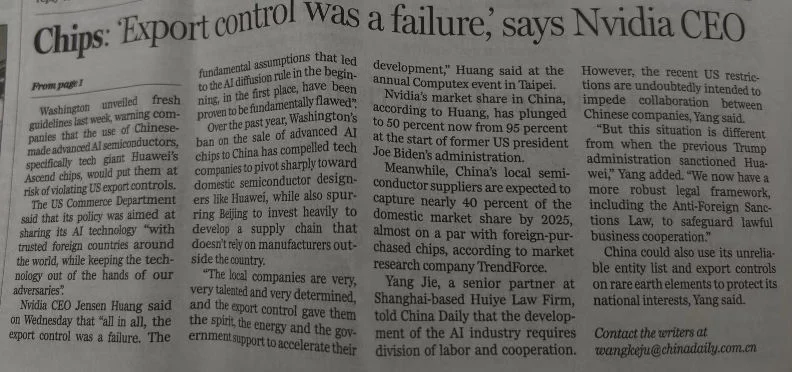
Last week, Washington issued updated guidelines cautioning companies that using advanced AI semiconductors made in China, specifically Huawei’s Ascend chips, would put them at risk of violating US export controls. The US Commerce Department stated that its policy aims to share its AI technology with “trusted foreign countries around the world while keeping the technology out of the hands of our adversaries.” However, Nvidia CEO Jensen Huang stated on Wednesday that “All in all, the export control was a failure. The fundamental assumptions that led to the AI diffusion rule in the beginning, in the first place, have been proven to be fundamentally flawed.” Over the past year, the restrictions on the sale of advanced AI chips to China by Washington have led companies towards domestic designers and are therefore spurring Beijing to invest.
Over the past year, Washington’s ban on the sale of advanced AI chips to China has compelled tech companies to pivot sharply toward domestic semiconductor designers like Huawei, while also spurring Beijing to invest heavily to develop a supply chain that doesn’t rely on manufacturers outside the country.
“The local companies are very, very talented and very determined, and the export control gave them the spirit, the energy, and the government support to accelerate their development,” Huang said at the annual Computex event in Taipei.
Comment: Notice how the media are deliberately misinterpreting what Jensen Huang, the CEO of Nvidia, said about the government support to accelerate project developments in semiconductors. The article wrongfully implied the “government” as China’s government, but obviously it is not correct. Misinformation and disinformation are serious problems that I have observed in China.
Tariffs make the “American Dream” unreachable for most
After Walmart declared it would raise prices due to tariffs imposed by his administration, then US President Donald Trump criticized the retailer. He suggested the company should simply “eat the tariffs” (eat the tariffs) and “not charge valued customers ANYTHING.”
Trump expressed on social media that “Walmart should stop trying to blame tariffs as the reason for raising prices throughout the chain.” He declared he and Walmart customers would be watching the company’s actions.
Studies suggest Walmart will not be alone in passing tariff costs to consumers, and the “American Dream” will become even more unattainable for the majority of people.
An analysis by the Ludwig Institute for Shared Economic Prosperity, which monitors the Minimal Quality of Life Index (MQL), revealed that a “minimal quality of life” remains out of reach for the lowest 60 percent of US households. The study considered basic necessities such as housing, food, and healthcare, alongside education, transportation, technology, leisure, and other essential components of well-being.
Comment: There is no doubt that in the short term, while the new supply chain needs transition time to move from China to other countries, a wide range of consumer products will be influenced by the tariff. The purpose of the time extension to postpone the reciprocal tariff will allow businesses that are dependent on global imports to have enough time to develop new sources of suppliers. The impact for Chinese exports will gradually be worsen as more importers starts to source materials from China alternative countries.
Conclusion: Uncertainty Risks Are Still High
As the old saying goes, action speaks more than words. If China really wants to be part of the global trading community, they need to start to act in a way that aligns with the international protocol and set universal values. The political system, just as the global supply chain is also going towards, needs to be more transparent and more systematic with independent authorities that can operate with integrity and fairness.
Over the pandemic time, China was exposed for its problematic policy making and governance. This has a gradual impact for multinational corporates and investments. The decoupling of US and China trade would further devastate China’s capability as the global manufacturing center. Investments and new supply chains (Chinese exports) are being diversified into other countries, and these investments would not be returning to China, as investment risks are just too hard to manage when political uncertainty risks are just too high.
Across various building material industries and flooring industries, this trend is already very obvious. The rise of manufacturers in Vietnam, Thailand, Mexico, and even domestically in the United States has some indication otherwise of the Chinese exports of these products. Unless the conditions has changed, especially with the tariff that is currently putting in place, Chinese exports will continue to struggle overtime.