
You might be surprised that there are many misleading facts that flooring brands does not tell you. Some of these could be related to environmental healthiness that impact you directly, and some of these are associated with the quality and performance of your flooring products. The truth is, the flooring industry has been telling many misleading information that trick consumers of thinking something otherwise. Here in this article, we uncover 6 secrets that flooring brands does not tell you truthly.
6 Secrets in Flooring Industry

- Luxury Vinyl is nothing Luxurious
- 100% Recyclable is Not Practically Recyclable
- Waterproof is not really waterproof. It depend on how you interpret the definition subjectively
- Eco-Friendly Flooring is Not a Unique Class of Flooring
- Acclimation Requirement is an Excuse for Low Quality Flooring
- Toxic Free might not really be Toxic Free
1. Luxury Vinyl is Nothing Luxurious
As flooring consumers, you might be surprised that the naming of luxury vinyl flooring has only been around since 1970s. As the flooring brands already has homogeneous flooring that is known as the PVC roll flooring, the industry try to avoid the use of the term “PVC” as there was a major movement for plastic wastes back in 1960s. So when marketer were trying to give new names that disassociate the product from plastics, they eventually turn to the name of Luxury Vinyl. The general public does not fully aware or understand the abbreviation meaning of vinyl at time, and so the industry got away with such marvelous naming.
What is luxury about the tile style resilient flooring is the fact that different designs can be applied onto the PVC flooring surface, at smaller production scales too. The ability to use different pavement pattern styles simply differentiated itself away from homogeneous flooring where change in pavement are not available. Considering it more luxury in the way it can have different design and pavement, but in terms of material compositions, there is not a huge distinct between homogeneous floorings and luxury vinyl tiles.
2. 100% Recyclable is Not Practically Recyclable
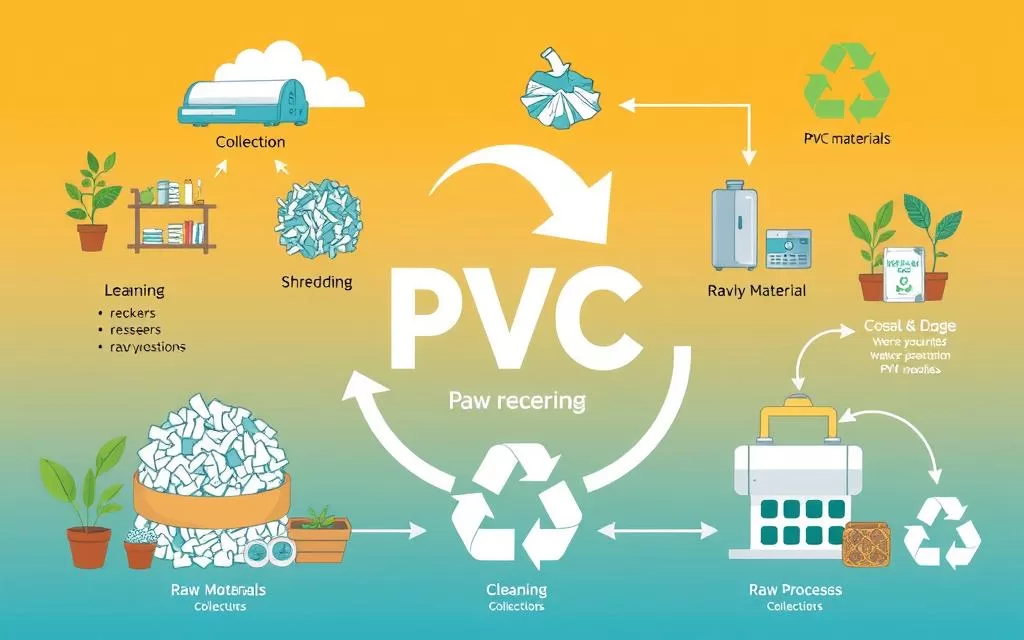
When flooring brands claim that their LVT and SPC flooring can be 100% recycled, they are not fully wrong. In theory, all plastics can be recycled. However, when it comes to recycling of PVC polymers, it generally needs to go through a chemical recycling methods which requires more chloride chemicals to be added. Not only it has some of the highest energy consumptions when recycling, the need for additional chemicals to be added defeats the purpose of recycling sustainably.
In addition, according to statistics, plastic recycling rate and efficiency are only less than 5 to 7% for all type of polymers. While flooring brands such as Tarkett, Gerflor, and others are working on improving its recycling rate by implement local recycling and take back schemes, from a boarder scale there are still significant improvements needed, especially for individual flooring importers, private label brands, and even global manufacturers which lack an effective system and scale to recycling.
Resilient flooring that is globally sources from afar, such as from China, Vietnam, Thailand, Korea, Taiwan, and India, are facing a global supply chain issue when it comes to recycling. Flooring distributors and flooring private label brands does not have the capability to initiate any recycling nor product take back scheme.
3. Waterproof is Not Really Waterproof. It depend on how you interpret the Definition Subjectively
Waterproof is a funny word in floorings. There are waterproof vinyl floorings, and there are waterproof laminate floorings.
For vinyl floorings, such as LVT and SPC, the definition for waterproof from the products’ perspective is okay. As polymer based compositions are naturally not vulnerable to moisture damage, its physical properties will not change from extensive time of water and moisture exposure. However, the flooring as a whole can not protect moisture from penatrate between the tiles, therefore the subfloor and the foundation will not be waterproof even if LVT and SPC floorings are installed.
For laminate flooring, the recent product launch for the so called waterproof laminate flooring, is actually a miss leading claim. From the material itself, the waterproof laminate flooring is made from high density fiberboards (HDF). As long as the HDF is made from wood based fibers, naturally it will absorb moisture. Over extensive times, the absorbed moisture will cause the plank to swallow and deform, which is considered a damage to the flooring. Even with improved composition and density in black core HDF materials, the moisture absorption rate only improved from 15% to under 10%, which by definition should not be called waterproof.
Another saying is that waterproof laminate flooring is waterproof as it prevents moisture from penetrating from surface and between tiles. The wax coating at the edge of waterproof laminate can effective barrier the moisture from penetrating. However, this type of waterproof quality is far away from the real waterproof concepts. A more ethical and professional laminate flooring suppliers would never claim their laminate flooring are waterproof, but addressing it as high water resistant laminate flooring.
4. Eco-Friendly Flooring is Not a Unique Class of Flooring
Environmental sustainability is an increasing topic in building materials industry as well as for floorings. With more consideration to launch a more eco-friendly flooring products, major brands and suppliers are innovating with new source of materials. As it is observed, the flooring market has some strange phenomenon. Just as marketers are marketing high water resistant laminate floorings as waterproof laminate floorings, another name was launched as the Eco-Friendly Flooring. Formulated with recycled wood composition, some brands are claiming that it is a revolutionary flooring product that is not a laminate flooring. Unfortunately, the definition of laminate flooring considers the use of (compressed) density boards with deco paper and melamine protective layer, therefore even if its made from resin and not wood base, it would still be considered a laminate flooring. They try to avoid the terminology of “laminate” as it used to be associated with toxic floorings.
Other Types of Laminate Flooring
- Mineral Fiber Board MFB Laminate Flooring
- Recycled rPCB Laminate Flooring
- Hemp Flooring
- And more…
5. Acclimation Requirement is an Excuse for Low Quality Flooring
It is unfortunate that current vinyl flooring products are actually produced with minimal industry standards, such as Floorscore. For example, when it comes to dimensional stability, floorscore standard has an allowance for 0.2%. Curling rate allowance by Floorscore is 2.0mm.
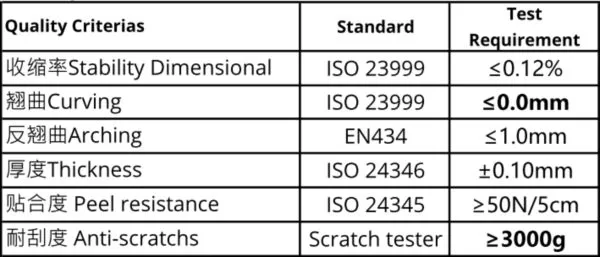
With acclimation free LVT, the stability dimensional requirement is less than 0.12% and curving rate be less than 0.0mm. This will make sure that even with PVC based composition, it will not deform or curl even when facing temperature change between warehouse to residential houses.
The need for acclimation time is an excuse for not providing a better quality flooring products. The resilient flooring industry are able to make more durable and stable LVT products but are not doing so due to minimal industry standards and cost competition.
6. Toxic Free Might Not Really Be Toxic Free
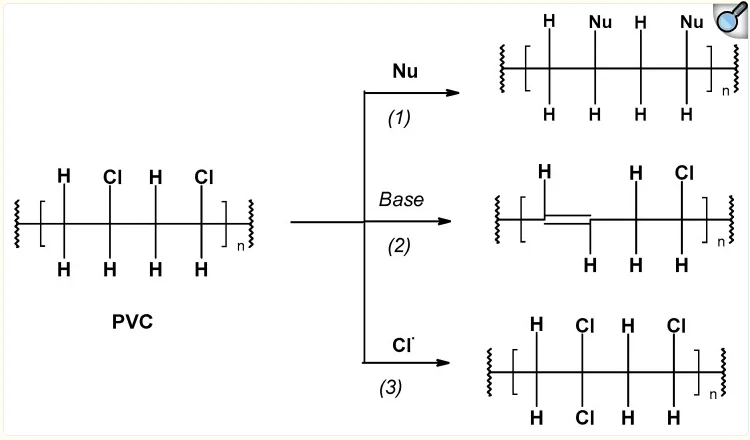
Very much all flooring brands are marketing their LVT and SPC flooring as a toxic free product. However, this is not entirely true because all polymers will gradually degrade due to presence of natural UV light and heat. Though the process is very slow, it will still release very little concentration of hydrogen chloride (HCI). The new vinyl flooring will have less risks for toxic release, but old vinyl floorings with more than 10 years of age will have an exponentially increase risks.